Phone
+33 (0)1 76 54 08 64
Address
66 avenue des Champs-Élysées
75008 Paris – France

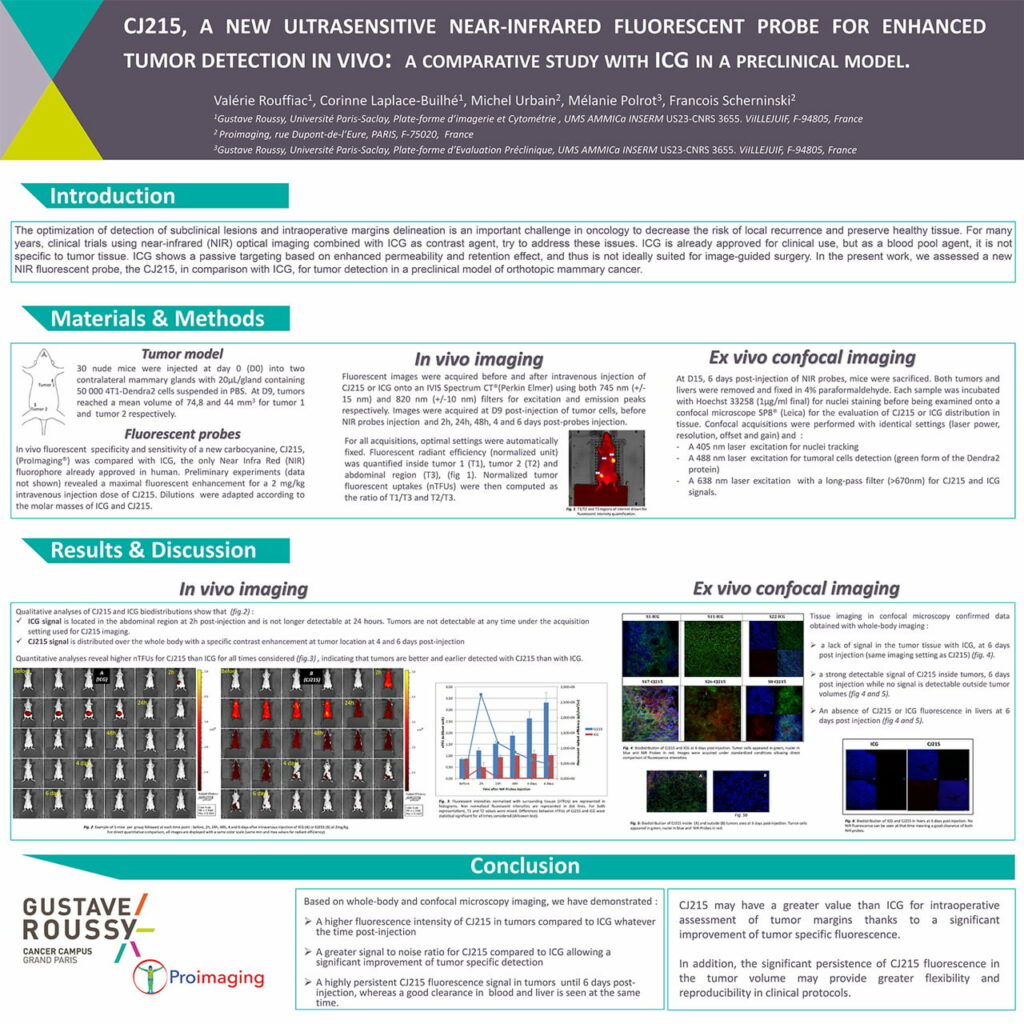
Authors: Valérie Rouffiac, Corinne Laplace-Builhé, Michel Urbain, Mélanie Polrot, François Scherninski
Abstract: The optimization of detection of subclinical lesions and intraoperative margins delineation is an important challenge in oncology to decrease the risk of local recurrence and preserve healthy tissue. For many years, clinical trials using near-infrared (NIR) optical imaging combined with ICG as contrast agent, try to address these issues. ICG is already approved for clinical use, but as a blood pool agent, it is not specific to tumor tissue. ICG shows a passive targeting based on enhanced permeability and retention effect, and thus is not ideally suited for image-guided surgery. In the present work, we assessed a new NIR fluorescent probe, the CJ215, in comparison with ICG, for tumor detection in a preclinical model of orthotopic mammary cancer.
The efficacy of fluorescence-guided surgery in facilitating the real-time delineation of tumours depends on the optical contrast of tumour tissue over healthy tissue. Here we show that CJ215—a commercially available, renally cleared carbocyanine dye sensitive to apoptosis, and with an absorption and emission spectra suitable for near-infrared fluorescence imaging (wavelengths of 650–900 nm) and shortwave infrared (SWIR) fluorescence imaging (900–1,700 nm)—can facilitate fluorescence-guided tumour screening, tumour resection and the assessment of wound healing...
The efficacy of fluorescence-guided surgery in facilitating the real-time delineation of tumours depends on the optical contrast of tumour tissue over healthy tissue. Here we show that CJ215—a commercially available, renally cleared carbocyanine dye sensitive to apoptosis, and with an absorption and emission spectra suitable for near-infrared fluorescence imaging (wavelengths of 650–900 nm) and shortwave infrared (SWIR) fluorescence imaging (900–1,700 nm)—can facilitate fluorescence-guided tumour screening, tumour resection and the assessment of wound healing...
The efficacy of fluorescence-guided surgery in facilitating the real-time delineation of tumours depends on the optical contrast of tumour tissue over healthy tissue. Here we show that CJ215—a commercially available, renally cleared carbocyanine dye sensitive to apoptosis, and with an absorption and emission spectra suitable for near-infrared fluorescence imaging (wavelengths of 650–900 nm) and shortwave infrared (SWIR) fluorescence imaging (900–1,700 nm)—can facilitate fluorescence-guided tumour screening, tumour resection and the assessment of wound healing...
Proimaging